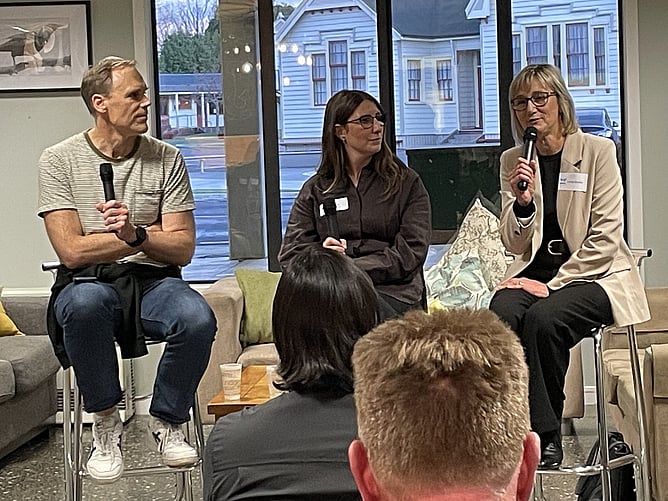
As artificial intelligence becomes increasingly embedded in day-to-day business, many organisations are discovering that technology alone is only part of the equation.
That was the key message from the latest Waipā Tech Meetup, which brought together local founders, business leaders and professionals to explore the human impact of AI and its implications for recruitment, workplace culture, leadership and career development.
Facilitated by Rocketspark founder and CEO Grant Johnson, the discussion featured Dannielle Mickleson, Head of People and Culture at LondonGreen Group, and Linley Steele, founder of Great People Recruitment.
While AI is often discussed in terms of productivity, efficiency and automation, the panel encouraged attendees to think more broadly about how workplaces, teams and individuals are adapting to rapid technological change.
One of the strongest themes of the evening was the impact AI is having on recruitment. Linley said AI-generated cover letters have become almost impossible to ignore.
"The majority of cover letters we now see have clearly been generated using AI tools," she said.
While tech can help candidates organise their applications, recruiters are often seeing documents that look very similar. As a result, CVs and cover letters aren’t standing out like they used to.
"Everyone can look great on paper now," Linley explained. "The challenge is understanding who people really are, how they think, and whether they're the right fit for the organisation."
She said that many organisations are redesigning their recruitment processes, relying more heavily on video interviews, practical exercises, psychometric assessments and scenario-based testing to better understand candidates, a development of particular interest to those in the room supporting job seekers into work.
For employers, the conversation is shifting away from polished applications and towards authentic capability.
Dannielle shared examples of how AI is helping teams work faster and deliver outcomes more efficiently. Tasks that once took hours can now be completed in minutes, allowing employees to focus on higher-value work. However, she warned that faster isn't always better if organisations fail to think about what happens next.
"The goal shouldn't simply be replacing work with more work," she said.
Instead, businesses have an opportunity to reinvest that time into customer relationships, innovation, problem-solving and strategic thinking.
The discussion highlighted an important shift. AI is no longer just a technology conversation. It's becoming a workforce design conversation.
The concept of AI fatigue was also brought into the discussion. As AI tools generate responses instantly and allow people to move rapidly between tasks, employees can find themselves working in much shorter bursts of concentrated effort throughout the day.
While that creates obvious efficiency gains, it can also increase cognitive load as people switch between activities more frequently.
The panel discussed the emergence of "always-on" behaviours, in which employees feel compelled to continually check outputs, refine prompts, revisit projects, or experiment with new tools outside normal working hours. As AI becomes more deeply integrated into workplaces, businesses may need to consider how they support wellbeing and establish healthier expectations around its use.
Perhaps the most thought-provoking discussion of the evening centred on junior roles and career pathways. Historically, many industries have relied on entry-level positions to provide practical experience and to develop future leaders. But if AI can handle an increasing number of routine or administrative tasks, what happens to those opportunities?
Danielle suggested organisations may need to rethink traditional structures and place greater emphasis on mentoring, collaboration and real-time knowledge transfer.
Rather than expecting people to work their way through repetitive tasks, future career development may involve closer partnerships between senior and junior employees, supported by AI.
Linley believes human oversight will remain essential.
"We still need people who can apply judgement, context and critical thinking," she said. "Technology can support the process, but it doesn't replace the human element."
While the discussion covered everything from AI-generated applications and recruitment practices to workplace wellbeing and organisational structures, one message stood out above all others.
The future of work isn't about humans versus AI; it's about how organisations combine technology with human judgement, creativity, leadership and connection.
As businesses continue to adapt, those that keep people at the centre of the conversation are likely to be best positioned for long-term success.