Our final Waipā Tech Meetup for 2026 brought together one of our biggest audiences of the year for a practical and compelling look at how businesses and technology teams are using AI today.
While the session was originally promoted as a deep dive into Claude, the pace of change across the major large language models (LLMs) means the lessons shared were highly relevant regardless of whether attendees are using Claude, ChatGPT, Gemini or other AI tools.
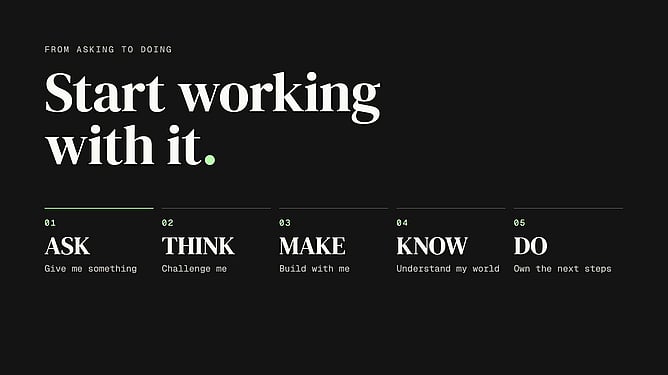
AI consultant and product designer Paul Osborn challenged attendees to rethink how they engage with AI, sharing a five-stage framework that reflects the increasingly sophisticated ways people are using these tools.
1. Ask
Most people start here: writing a prompt and expecting an answer. While this is important, Paul explained that simply asking AI to produce something is only the beginning. To unlock greater value, users need to move beyond transactional prompting and start treating AI as a thinking partner.
2. Think
One of the most powerful techniques Paul demonstrated was asking AI to challenge your thinking. Rather than seeking agreement, he regularly asks AI questions such as:
What am I missing?
Why won't this work?
What assumptions am I making?
What questions should I be asking?
Used well, AI can become a valuable tool for stress-testing ideas, identifying blind spots and broadening perspectives.
3. Make
The next stage is building alongside AI. This is where more advanced prompting techniques become important. Providing clear instructions, iterating on outputs and refining requests can dramatically improve results and help AI become a genuine collaborator rather than simply a content generator.
4. Know
A key theme of Paul's presentation was the importance of context. The quality of AI outputs is closely tied to the quality of information provided to it. Investing time to give AI detailed background, project information, goals, constraints and organisational knowledge leads to significantly better outcomes.
5. Do
The final stage moves beyond prompts and into execution. Paul shared examples of creating applications and digital products where AI is supported by structured product requirements, design principles, constraints, review processes and detailed testing scenarios.
The lesson was clear: successful AI projects rely on systems, process and context, not just a great prompt.
The second session featured Richard King, co-founder and CTO of Rocketspark, alongside his colleague Lee Reichardt, also co-founder and senior developer. They shared their team's hands-on experience integrating AI into software development.
Their story highlighted how AI usage has evolved from simple code completion tools to more sophisticated AI agents capable of coding, reviewing software and helping resolve issues.
However, the Rocketspark team was equally candid about the challenges.
Faster code generation does not automatically produce better software. Teams still need robust processes for review, testing and maintenance to ensure AI-generated output delivers genuine value.
One of the strongest messages from the Rocketspark team echoed Paul's earlier presentation, which is that context matters.
The team shared examples of how capturing organisational knowledge, project decisions, standards and expertise can significantly improve AI outputs and create something closer to a shared organisational knowledge base or "company brain".
They also discussed the importance of bringing the entire team on the journey. Regular workshops, shared learning and collaborative experimentation have helped build capability across the organisation and ensure AI adoption is not limited to a handful of experts.
Common themes emerged
Despite approaching AI from different perspectives, both presentations arrived at similar conclusions:
AI is evolving at an extraordinary pace.
Better context produces better outcomes.
Shared organisational knowledge is increasingly valuable.
AI works best as a collaborator, not just a tool.
Continuous learning and experimentation are essential.
Successful adoption is as much about people and process as technology.
For attendees, the evening provided a practical reminder that getting value from AI is not about finding a magic prompt. It is about building the habits, knowledge and systems that allow AI to become a trusted part of how work gets done.
What's ahead for the Waipā Tech meetups?
The event provided a fantastic way to close out the year.
A huge thank you to Paul Osborn, Richard King, Lee Reichardt and everyone who joined us throughout the year.
We'll be back in 2027 with more conversations, insights and opportunities to connect with the growing Waikato technology community. Watch this space!
For further reading, check out Richard King's summary of key AI learnings from Rocketspark, which expands on many of the themes discussed during the session.